Announcing React Native bindings for NobodyWho
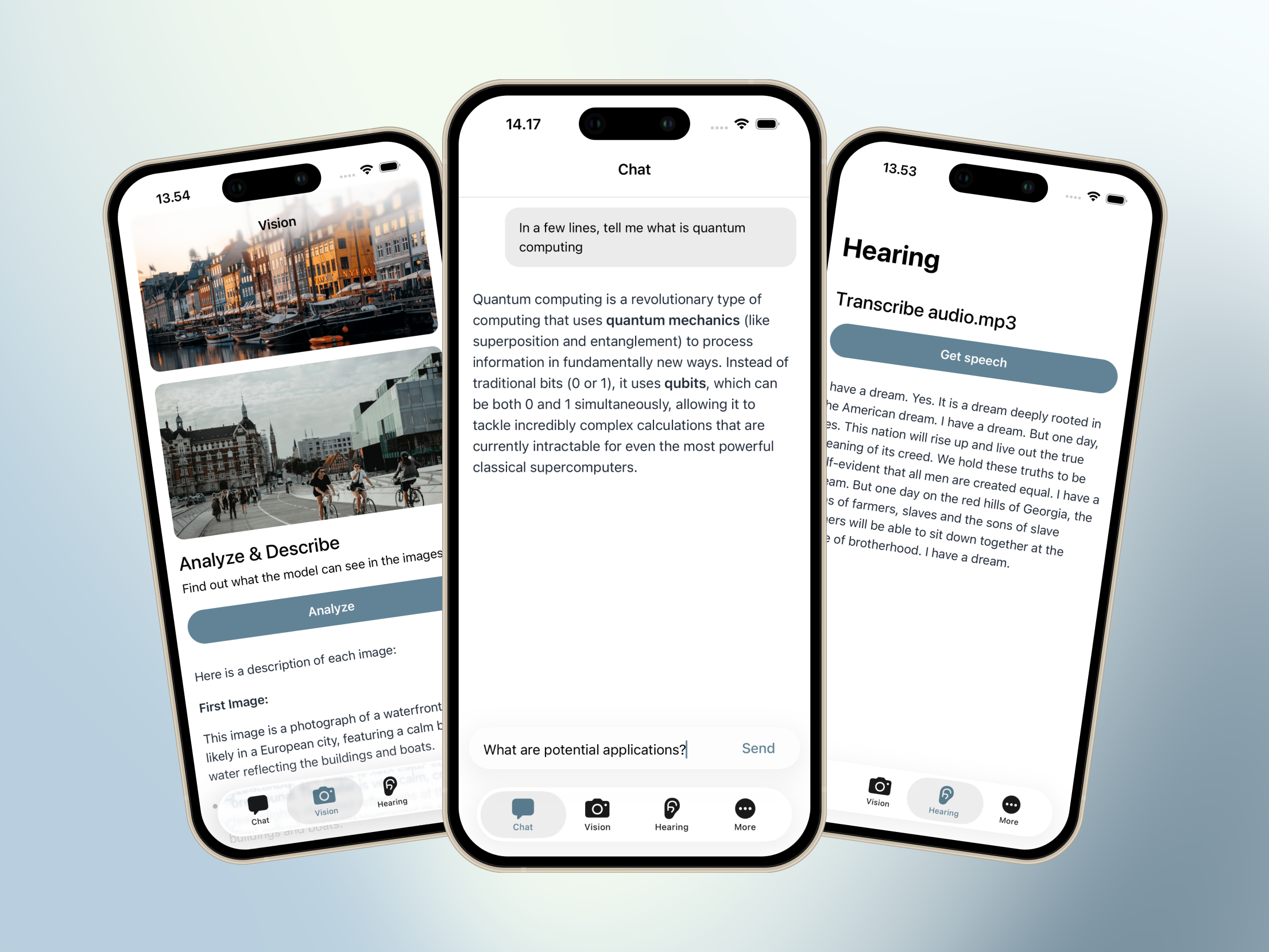
You can now npm install react-native-nobodywho and ship an LLM that runs entirely on your users' phones. No API keys, no servers to babysit, no per-token bill at the end of the month — just a .gguf file on the device and a chat loop in your app.
Why on-device?
Most AI features in mobile apps today route every request through a hosted API. Running the model directly on the user's device is a different shape of product, and it brings real benefits:
- Privacy by design — user data never leaves the device
- Works offline — no internet connection required
- Low latency — no network round trip on every interaction
- No cloud costs — inference is free, no per-token billing
The tradeoff is raw capability — local models are smaller than frontier cloud models — but for chat, summarization, classification, and many agentic workflows they're more than enough.
What you get
The React Native bindings expose the same core API our Godot, Rust, Python, and Flutter users already know, including:
- Streaming chat with full token-by-token output
- Tool calling, so the model can call into your JS/TS code
- Sampling controls (temperature, constrained/JSON output, …)
- Embeddings and a cross-encoder for RAG
- Feed image and audio inputs directly to your LLM
- Any model in
.ggufformat, powered by llama.cpp under the hood
It works on both iOS and Android.
Getting started
npm install react-native-nobodywhoA minimal chat looks like this:
import { Chat } from "react-native-nobodywho";

const chat = await Chat.fromPath({ modelPath: "/path/to/model.gguf" });

for await (const token of chat.ask("Is water wet?")) {
  console.log(token);
}
For the full setup — picking a model, getting the .gguf onto the device, wiring up a streaming chat UI — see the React Native documentation and the starter example app on GitHub.
One core, many languages
React Native joins a growing list of first-class NobodyWho targets. The same Rust core — wrapping llama.cpp — now powers bindings across:
- Godot — drop-in nodes for game dialogue, NPCs, and tooling
- Rust — the native API the rest are built on
- Python — for scripting, prototyping, and ML workflows
- Flutter — cross-platform mobile and desktop apps
- React Native — and now the JavaScript/TypeScript mobile ecosystem
That's the whole point of NobodyWho: one well-maintained inference core, with idiomatic bindings for whichever language or framework you actually want to ship in. Every binding gets the same feature set — streaming, tool calling, sampling, embeddings, RAG — so you don't have to give up capabilities to use the language you prefer.
Join the community
We'd love to hear what you build with the new React Native bindings — and meet the people building with NobodyWho across all the other languages too.
- Discord — the best place to ask questions, share what you're working on, and chat with the team and other NobodyWho users.
- GitHub — open an issue if you hit a bug, or a discussion if you have an idea.
Happy hacking!
Everything NobodyWho do is open-source, please leave a star on Github to support us ❤️
Published Apr 27, 2026 by Asbjørn Olling